Showing posts with label Fiori. Show all posts

Wednesday, June 11, 2014

Fighting Complexity: Can SAP Run Simple?

When it comes to enterprise software vendors, SAP wants to be not just the largest but also the most simple. That’s the message behind SAP’s new theme, “Run Simple,” rolled out at its annual SapphireNow user conference in Orlando last week.

At first glance, the theme of simplicity is an odd one. For over 20 years, SAP has been widely regarded as having software that is functionally rich but enormously complex. Its name has become synonymous with implementation projects that run into the tens, even hundreds, of millions of dollars, sometimes ending in failure or at least in organizational exhaustion. SAP is easy to stereotype.

Newly appointed to the sole CEO role, Bill McDermott set the tone in his kick-off keynote: SAP customers need to “fight complexity,” to simplify how they interact with their customers, starting with how they deal with their own workforce. At the same time, McDermott acknowledged that SAP itself has been part of its customers’ complexity. But n

McDermott is an inspiring and disciplined speaker. But fulfilling this vision will take more than an inspiring keynote. In my view, if SAP really wants to beat complexity, it will need to run simple in three ways: in its products, in its ongoing support, and in how it deals with its customers. So, let’s look at each of these.

Simple Finance the First Step toward a Simplified Business Suite

On the first day of the conference, SAP announced the future delivery of Simple Finance. As I see it, Simple Finance will be a major new release of SAP financial applications (starting with FI and CO) as the first SAP Business Suite products to undergo radical code optimization to take advantage of HANA, SAP’s in-memory database technology.

Based on interviews and a demonstration I received on the show flow, I see at least three ways that Simple Finance is, well, simpler.
  • A simpler code base. Under HANA the applications can now simply record transactions and not have to create any summarized data fields for later reporting. With HANA, reporting always goes back to the source data in memory to build aggregated data fields on the fly. This shrinks the size of the programs, greatly reducing the number of lines of code, making them less error-prone and easier to debug. It also means that users can now drill down from summary data to details in any way they choose, without having to write special reports or customize the code.
     
  • A simpler user interface. SAP Fiori provides the user interface for Simple Finance. Fiori apps operate across desktop and mobile devices to provide a simplified user interface for SAP’s applications. They are not just a new presentation layer but in many cases combine SAP transactions into a single user process. For example, entering a manual payment in Accounts Payable can now be done in a single screen instead of the multiple screens it previously required in SAP. On a side note, after much push-back from customers, SAP announced that Fiori apps will now be delivered at no charge to customers under maintenance, removing one barrier to adoption of Simple Finance.
     
  • Simpler to implement. Implementation tools and methodologies are built right into the application, based on SAP’s previous work with its Rapid Deployment Services. These include wizard-like tools to guide and configure the applications. There are data migration tools to map data from existing systems into Simple Finance—whether from previous versions of SAP or from other systems. Implementation testing is also managed within the system itself. In addition, Simple Finance is integrated with SAP’s collaboration system, Jam, to encourage knowledge exchange. If a user runs into problems, for example, he or she can reach out to other users for help.
A date for general availability of Simple Finance has not been announced, only that early ramp-up customers are about to start implementation. Following Simple Finance, other parts of the Business Suite will also be “Simplified” until the entire product becomes a “Simple Suite.”

SAP personnel demonstrating Simple Finance appeared genuinely excited about the product. One indicated she was slated to work on implementations with early adopters. She said that she had even signed up some ramp-up customers earlier that day on the show floor, indicating a high level of interest.

I am optimistic that new prospects will find Simple Finance much more attractive than older versions of SAP financial systems. Simple Finance will be better received by midsize organizations that might have been otherwise scared off by the size, scale, and perceived complexity of SAP Business Suite. Score one for SAP.

My take: product simplification is the most straightforward mandate facing SAP. For the most part, it is only a technical challenge. SAP is loaded with software engineers, and HANA does represent a new paradigm for how business systems are architected. This is not to say there won't be bumps along the road, but I am hopeful SAP will get there.

Cloud Deployment Simplifying Ongoing Support

SAP also wants run simple in how customers keep their applications up-to-date. Like most traditional on-premises vendors, the majority of SAP customers are not on the latest releases of its products. The reason is that applying new versions (in SAP lingo, “enhancement packs”) is often a labor-intensive activity—testing the new code, retrofitting any customizations, regression testing to be sure nothing gets broken, and migrating data.

SAP’s solution is to take over these responsibilities by hosting customers’ systems in SAP’s HANA Enterprise Cloud (HEC). This program, already rolled out to some early SAP customers, is essentially a managed services offering in which SAP takes all responsibility for day to day operation of the system in SAP’s own data centers. Notably, SAP also takes responsibility for keeping the customer’s system up to date with the latest enhancement packs and bug fixes. It even supports systems with custom modifications.

The managed services offering should allow the customer’s IT personnel to focus less on technical aspects and more on business process design and effective use of the system.

My take: simplifying SAP’s ongoing support by moving customers to its managed services offering
will be more of a challenge. Only a tiny fraction of SAP’s customers are committed to this offering today. There is likely to be much inertia in SAP’s installed base about having SAP host their systems. Even though customers may be experiencing pain, many will view migration as short- term cost and effort for long term benefit. It may all come down to how SAP prices its managed services offering. If existing customers do not take up SAP on the offer, they will not experience much simplification in their SAP support experience, and SAP will retain its reputation for complexity.

Many other vendors have tried this approach—in particular, Oracle. Although most customers of Oracle Fusion Applications (Oracle’s next generation apps) are reportedly choosing the hosted deployment offering, I do not believe Oracle is seeing a mass migration of its preexisting applications, such as E-Business Suite, Siebel, JDE, or PeopleSoft, to its hosted delivery model. Will SAP’s experience be any different? I have my doubts.

Making SAP Simple to Deal With

The third way in which SAP must run simple is in its customer-facing processes. How easy is it for customers to deal with SAP? McDermott did not spend as much time in his keynote on this point, but he did emphasize it toward the end.

“Run Simple is more than a slogan for SAP--it is an organizing principle for our company,” he said. “We'll ask the tough questions: do our products and technologies run simple? Does our customer experience run simple? Are we empowering our employees to run simple? And are we enabling our customers and our partners to run simple? If not, hold us accountable.”

He continued: “For customers, we're committed to a beautiful user experience. We will make it simple to do business with SAP: simple pricing, pay-as-you-go in the cloud, simple web experience.”

Those are big promises. Anyone who has negotiated an acquisition of SAP software knows that SAP contracts are incredibly complex.  Pricing is opaque, with many various types of named users defined for each product. SAP’s terms and conditions around indirect access (when other systems access information from an SAP system) are onerous.

The result is that it is nearly impossible for an SAP customer to be fully compliant. When SAP does an audit of a customer’s use of SAP products—which it has the right to do—it will find problem, if it looks hard enough.

Even finding the right person in SAP's organization to deal with is not a simple matter. Whether it is the result of having a worldwide organization or peculiarities of German corporate governance, it is difficult to understand who reports to whom, or who is responsible for what.

Lars Dalgaard, founder of Successfactors, recently commented about SAP’s organizational problems.  “[SAP has] this messed up reporting structure where nobody reports to anybody,” Dalgaard said. “It’s this German thing where I didn’t even report up to Bill [McDermott] myself, I was reporting to the Supervisory Board. That doesn’t work. It just doesn’t. I mean, the COO doesn’t report up to the CEO?”

Dalgaard was positive about McDermott’s new role, however. “Someone has to be the decider, and with Bill, now they’ve got a decider on the job, I can tell you that,” he said.

The complexity of SAP’s organization not only affects customers; it affects anyone who has to deal with SAP. Talk to SAP partners, third-party developers, SAP suppliers, and industry analysts—nearly all of them say the same thing. SAP’s organization and decision-making processes are extremely difficult to navigate.

Following McDermott’s recent appointment to the role of sole CEO, SAP underwent a major reorganization, laying off an undisclosed but apparently significant number of employees. SAP claims this was not to cut costs but to better align the organization with SAP’s strategy. If so, the reorganization could be consistent with an attempt at simplification.

My take: SAP’s organization and customer-facing processes will be the most difficult to simplify. Technical simplification is an engineering problem. Support simplification can be solved if SAP can motivate customers to take up its managed services offering. But making SAP simple to deal with requires cultural change.

SAP’s culture manifests itself in how people are measured. One example: why did it take an outpouring of customer wrath for SAP to release Fiori at no charge to customers under maintenance? One source close to SAP told me that, within SAP, product groups are measured by their impact on revenue. If there is no revenue from Fiori, there is little recognition for Fiori developers. I have to believe that many SAP executives understood the opportunity in delivering Fiori at no charge. Some of us have argued that SAP stands to make more money by delivering Fiori at no charge (because it pulls through greater revenue opportunities with HANA and additional user seats). So, why wouldn’t SAP make this move sooner? If my source is correct, it is because that general lift in revenue would not be attributable to Fiori.

When you change program code, the program doesn’t fight back. But when you try to change a large organization, the organization often resists. Having a sole CEO will help, and McDermott appears determined. But has there ever been an example of a large organization that has become less complex over time?

What Does “Run Simple” Mean for Enterprise Tech Buyers

Large tech vendors change their marketing messages periodically, with no change to their core strategy, values, or culture. Is “Run Simple,” merely a branding exercise, or will it be a reality in how customers experience SAP? Time will tell.

In the short term, Simple Finance deserves consideration. In looking for new financial systems, business leaders who might have otherwise dismissed SAP as too complex should take a look at Simple Finance. New and existing customers should also investigate SAP’s managed service offering. But be prepared for continued complexity in dealing with SAP.

SAP did not become a complex organization overnight and it certainly won’t be easy to simplify. McDermott specifically told customers in his keynote to hold SAP accountable. I hope they will do that. I also hope McDermott will follow up in next year’s user conference with a progress report.

Related Posts

What Fiori Means for SAP and Its Customers
Risks and Opportunities with SAP's Platform Economics
Mad as hell: backlash brewing against SAP maintenance fee hike

Monday, April 21, 2014

What Fiori Means for SAP and Its Customers

https://www.youtube.com/watch?v=M1CtjY7hsDM
Over the past several months, analysts and bloggers have been debating about whether SAP should offer its new user apps, Fiori, at no charge to customers under its maintenance program.

The debate can be difficult to follow for those not familiar with Fiori or SAP's technology stack. This post summarizes the debate, including factors not often recognized, along with my view on what SAP should do in its own best interest and what it all means for SAP customers.

What is Fiori?  

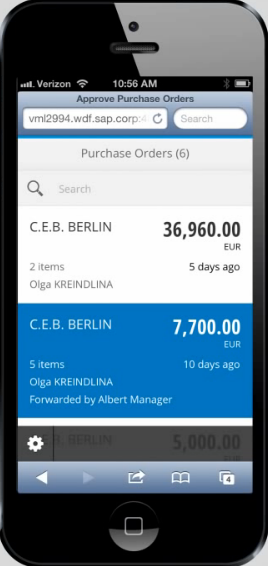
SAP Fiori is a set of apps, newly written by SAP, that address the most broadly and frequently-used SAP functions, such as workflow approvals, information lookups, and self-service tasks. They provide simple and easy-to-use access seamlessly across desktops, tablets, and smartphones.

To get a quick idea what Fiori is all about, watch this short video with examples of SAP Fiori apps for managers, or click on the image on the right.

Fiori is more than just a new user interface. It is a set of cross-device applications that allow users to start a process on their desktop, for example, and continue it on a tablet or smartphone. SAP is developing its Fiori apps based on its latest user interface framework, SAPUI5.

SAP lists three types of Fiori apps: 
  1. Transactional apps, which allow users to perform SAP transactions on mobile devices, as well as desktops. For example, there is a transactional app for creating a leave of absence request and another for approving a purchase order.
     
  2. Fact sheets, which display information about key business objects in SAP. For example, there is a fact sheet app for viewing a Central Purchase Contract, which allows a user to also drill down into related entities, such as vendor contacts, items under contract, and terms.
     
  3. Analytical apps, which allow users to display key performance measures and other aggregate information about the business.
A complete list of all the current Fiori apps is available on SAP's website. At the time of this writing, SAP has released two waves of Fiori apps, of 25 apps each, with additional waves underway.

It is important to note that Fiori will never be a comprehensive UI replacement for SAP.  In a back channel conversation, I learned that most SAP ERP processes cannot be done with Fiori, now or in the future. Those SAP processes are simply too complex in their design and do not lend themselves to deployment on a smart phone or tablet. Everyone knows, for example, that you can do a lot more with the desktop version of Netflix than you can on the Netflix iPhone or iPad app. Likewise, it is difficult to take a complex SAP process and dumb it down to the point where you can deploy it on a smartphone.

Complicating things, Fiori is not the only development effort involving SAP's user interface. SAP has also released a product dubbed Screen Personas, which allows users to customize standard SAP screens to their liking. For example, using Personas, a user could remove fields of no interest or change the placement of fields on the screen.

SAP Customers Are Pushing Back on Pricing for Fiori

The best source of information on the debate about Fiori pricing is a diginomica post written by John Appleby, an SAP expert who works for an SAP partner, Bluefin Solutions. Some of what follows borrows from Appleby's post and its long comment thread. 

The list price for Fiori is currently a one-time fee of $150 per user and it gives that user access to all current and future Fiori apps. That might sound like a good deal, until you consider several factors. First, as Appleby points out, that $150 per user fee can add up quickly. If a user only needs access to one or two Fiori apps (e.g. approvals), the $150 fee gets expensive in companies with thousands of such users. In the comments, Jarret Pazahanick points to one company that has 80,000 employees and would have had to pay $12M simply to let all of its employees view their pay stubs using Fiori. Nevertheless, Appleby points out that there are scenarios where Fiori is easily cost-justified such as when enabling the salesforce with a number of Fiori apps: the $150 fee per user is a no-brainer in such cases.

But, more basically: what are customers paying maintenance for? SAP's current maintenance pricing is 22% of the customer's license fee, which means that, in fewer than five years, the customer has essentially purchased its entire SAP product portfolio a second time. Customers look at Fiori as an extension of the SAP products they have already licensed. Why should they have to pay more money to SAP in order to license Fiori? 

As Chris Kanaracus found when he interviewed those in leadership positions from three major SAP user groups worldwide, SAP customers are up-in-arms over SAP's policy of charging them for Fiori. It's reminiscent of the customer revolt against SAP's forced march of customers to higher levels maintenance fees a few years ago. It is also reminiscent of SAP's struggles with how to charge for its mobility platform and the SAP Netweaver Gateway, back in 2011.

Strangely, SAP's policy toward existing customers appears to be harder than it is toward new customers. Back channel conversations indicate that when SAP is selling net new deals, it nearly always demonstrates Fiori--because it shows really well. When it comes to putting together a proposal, then, SAP typically bundles Fiori as part of the total deal. 

Yet, when an existing customer wants to buy Fiori, that customer needs to pony up $150 per user. The exception, of course, is when the customer has something else it wants to buy from SAP. Then SAP can wink and nod and bundle Fiori into the deal with the other SAP products the customer is buying. In other words, unless you are willing to buy something more from SAP, you have to pay for Fiori.

Other Vendors Provide New Functionality at No Charge

Some on Twitter have argued that SAP's policy is no different than that of other vendors. I disagree. Some other vendors have a much more liberal approach to delivering new functionality to existing customers under maintenance at no additional charge. For example, Workday recently rolled out a new user interface, and previous revisions added extensive mobile support. Workday didn't charge its existing customers extra for this new functionality.  Salesforce did something similar with its Salesforce1 platform, a major new release of its Force.com platform--at no additional charge.

Furthermore, it is not just the pure cloud vendors who provide new functionality at no additional charge. For example, Microsoft Dynamics recently announced major new CRM functionality at no additional charge to existing enterprise users (the top tier of users). This was not a user interface upgrade but totally new functionality from acquired products: a complete marketing automation system, from its acquisition of Marketing Pilot, a social media listening system, from its acquisition of Netbreeze, and a new service desk system, from its acquisition of Parature.

Finally, releasing new functionality at no charge already has precedent within SAP. For example, in 2012, SAP released a new product known as HR Renewal, which encompasses learning, employee and manager self-service, personnel administration, organizational management, and more. All of this was provided at no additional charge to customers under maintenance. See this blog post from Jarret Pazahanick for details (including the comments). I see no logic in how SAP can charge customers for Fiori, while releasing HR Renewal to existing customers at no charge.

But...Paying for Fiori is the Least of the Problem

The argument to this point is simple: customers are paying maintenance on existing SAP products, and Fiori is an enhancement to those products. Therefore, SAP should make it freely available to customers. This was and is my position. But, as it turns out, for most SAP customers who want Fiori, that $150 flat fee per user is the least of their problems. There are two other obstacles to Fiori:
  • Fiori needs current releases of SAP products. Some years ago, SAP introduced the concept of enhancement packs, whereby customers could selectively apply upgrades to individual SAP products instead of installing a completely new release. This approach is good: it lets customers can more easily install only the updates they really need or want. But it also means that many customers will not be completely up-to-date on all enhancement packs. Therefore, when a customer wants to install a Fiori app, the customer may first need to upgrade to a more current version of the product and install certain enhancement packs. Depending on how back-leveled the customer is, the upgrade can be a major effort. The prerequisites for each Fiori app are listed on SAP's website.  
     
  • Fiori needs HANA. Sometimes lost in the debate is the fact that, to use Fiori, customers need to be running HANA underneath their SAP products. SAP explicitly says that HANA is a hard requirement for Fiori fact sheet apps and Fiori analytic apps. For transactional apps, SAP says, somewhat cryptically, "They run best on an SAP HANA database, but can also be ported to other databases with acceptable performance." A back channel conversation with someone in a position to know, however, says that without HANA, Fiori transactional app performance is slow on mobile devices and, as a result, may not deliver a positive user experience.
Neither of these are small issues. One source with direct Fiori experience reports that the biggest problem is the effort required to upgrade SAP products and the expertise required to install Fiori. What percentage of SAP customers have all the upgrades and enhancement packs in place for Fiori? It is impossible to determine, but it cannot be a large percentage.

Another source points out that slow adoption of HANA is a major impediment to Fiori. Out of approximately 40,000 SAP Business Suite customers, only about 1,000 have bought Business Suite on HANA, and SAP doesn't say how many of them are live on HANA. Even if all of them are live on HANA, that is less than 3% of Business Suite customers. Charging for  Fiori is "a small barrier" in comparison to the need to implement HANA.

SAP Could Make More Money By Giving Away Fiori

So, if the price tag for Fiori is the least of customers problems, why not turn it around and ask, what would it mean if  SAP were to offer Fiori to existing customers at no charge?
  • It would give a positive reason for SAP customers to upgrade to HANA. The real opportunity, in my opinion, is not some small amount of revenue SAP might receive from sales of Fiori to existing customers. It is in moving those customers to HANA.

    SAP has staked its entire product strategy on HANA. Yet, as we have just shown, fewer than 1% of Business Suite customers have purchased HANA. If SAP wants to be successful, it must do everything it can to move customers to HANA. Yet, the business case for Business Suite on HANA to date has mostly been, in effect, "you can do things faster." Yes, there are a few dramatic examples, such as large companies being able to do a complete MRP regeneration in seconds instead of hours. But for most customers, "faster" is not enough to justify the time and expense of a HANA migration.

    Fiori changes that. SAP can now say, if you go to HANA, you can change the user experience of SAP with these Fiori apps. Fiori, in effect, could be the trojan horse for HANA.
     
  • It would sell more SAP user licenses. The only individuals who can use Fiori apps within a customer's organization are those who have a user license for the underlying SAP product. Fiori, therefore, may tip the scales in favor of getting more users licensed for SAP products.

    As Appleby wrote:
I don’t have any facts to support this, but it makes sense from a strategy perspective. Fiori Launchpad hosts multiple Fiori apps for a given person. If I’m a sales rep, then I could have approvals, accounts, and a bunch of other things. Each of these apps requires some user license of some kind....

If users are using Fiori, they will want new capabilities too, and those new capabilities have a sell-on, but only if people are using Fiori. Get customers on it, and get the account team in to sell-on.
Compared to the strategic value and revenue opportunities for moving customers onto HANA and selling additional user licenses, charging existing customers for Fiori is chump change.

SAP Has It Exactly Backwards

In summary, charging for Fiori is a big mistake for two reasons. First, it annoys customers, who need to see more value in SAP's maintenance program. True, it is unlikely that any single customer is going to migrate away from SAP simply because SAP is charging for Fiori. But SAP's stated policy reinforces the perception that there is not much value in SAP's maintenance program. SAP's most recently quarterly results show that SAP's core business--sales of its Business Suite--are shrinking. SAP, therefore, should be doing everything it can to keep the customers it already has.
 
Second, SAP in practice already gives away Fiori when it is part of a larger deal. As discussed earlier, nearly every Fiori deal to existing customers is by definition going to be a larger deal, either because the customer will need to license and implement HANA or because the customer will want to move additional users onto SAP in order for them to use Fiori.

In a subsequent email discussion, Appleby asks:
How can SAP positively motivate customers to move to SAP's innovation stack (HANA, Fiori, Hana Enterprise Cloud, etc.). This is where the good stuff will happen. Why isn't SAP bundling these three things together including the services to get customers there? Why doesn’t SAP take some of the risk up front to keep its relevance?
Taking it a step further, if Fiori is part of the key to moving customers onto SAP's latest technology stack, perhaps SAP should by paying customers to take Fiori, rather than charging them for it. The payment could be in the form of a moderate credit toward new user licenses or HANA licenses. Or, as Appleby proposes, a discounted bundle of products and implementation services.

Such a program would generate much good will among SAP's installed base and would further SAP's larger product strategy.

SAP Customers Should Investigate Fiori Possibilities

What does this mean for SAP customers? First, get up to speed on the Fiori apps currently available and show them to your end users. Long time SAP users are often jaded in their expectations, which means the bar is set pretty low. They will most likely be pleasantly surprised by the possibilities of Fiori. Screen Personas are another way to impress long-time SAP users with new possibilities. If they become supportive of Fiori and Screen Personas, they may give you the business case to make an investment.

Second, spend some time to determine what additional investments you will need to implement Fiori.  If you are like most SAP shops, you will need to upgrade some SAP products. You will also probably need to migrate at least some portions of your Business Suite to HANA. Or, at least you will want the option to do so if Fiori performance turns out to be unacceptable without HANA. You may also need some additional SAP user licenses.

Finally, talk to your SAP account representative about putting together a bundled deal for Fiori, Screen Personas, new user licenses, and the other technologies you will need, including HANA. Despite SAP's stated policy to charge for the new apps, it is likely that SAP will be quite willing to cut an attractive deal when there is a larger amount of money at stake. 

Update: Dennis Howlett had a post on diginomica last week where he delves into some of these same points.

Update, June 4, 2014: Better late than never. SAP, responding to pressure from its customers, announced during its annual user conference that Fiori apps and Personas will now be available to customers under maintenance at no charge. 

Related Posts

Risks and Opportunities with SAP's Platform Economics 
SAP innovating with cloud, mobile and in-memory computing
Mad as Hell: backlash brewing against SAP maintenance fee hike