Monday, February 27, 2012

The New Technology Elite: A Book and Author Review


My friend and associate Vinnie Mirchandani has written his second book, The New Technology Elite: How Great Companies Optimize Both Technology Consumption and Production. I asked Vinnie if I could write a review, and he provided a pre-release copy of his book.

I’d gotten bits and pieces of the book from Vinnie’s blog posts and excerpts he released on LinkedIn. But getting a look at the entire book is a whole other experience.

In this post, I'd like not only to review the book--I'd like to also review the author.

A Curious Mind

For regular readers of the Spectator, Vinnie needs no introduction. I’ve been quoting and linking to him for years, even before I met him in person, around 2007. Since then, we’ve become friends. Among industry analysts, Vinnie is someone I consider like-minded.

At the same time, though, Vinnie is something of a strange cat. As a former Gartner analyst and PwC sourcing executive, his background is in enterprise software and vendor management (his blog title, Deal Architect, gives that away).

But over the past several years his focus has shifted to technology innovation more generally. Ever restless, he launched a second blog, New Florence, New Renaissance, I suspect, to help him on his flights of fancy outside the walls of enterprise IT. This has taken him far afield into areas such as nanotechnology, healthcare IT, sustainability, consumer electronics, mobility, and dozens of other corners of technology innovation. From time to time I try to scoop him, by sending him a link to some cool new application of technology, when I spot it. But generally, he’s not only spotted it himself: he’s also written about it. I still try, though.

Vinnie’s interests led to his 2010 book, The New Polymaths: Profiles in Compound-Technology Innovations. There he chronicled dozens of case-studies of organizations that are leveraging a wide range of technologies to solve the world’s grand challenges and improve our lives. Now in his second book, The New Technology Elite: How Great Companies Optimize Both Technology Consumption and Production, he weaves more case-studies into a larger story.

In Vinnie's view, some organizations that are, historically, buyers of information technology, are now turning into technology providers—as they embed new technology into their products and services. Virgin America, 3M, GE, and UPS are examples. At the same time, leading technology providers, such as Apple, Google, Amazon, and Facebook are becoming examples of best business practices, such as in their data center operations, retailing units, and supply chains. He then presents a framework for understanding what these organizations have in common: their 12 key attributes.

He concludes by examining the outside influences affecting these organizations, including the regulatory environment, their impact on society at large, and the ability (or lack thereof) of sell-side financial analysts to understand it all. Lest one think Vinnie is an unabashed technology enthusiast, these last three chapters strike a counterbalance—it’s not all positive.

A Disorienting Experience

Reading the book leads to one overriding impression: the pace of technology change is unprecedented. Sure, we all know this, generally. But, most of us really don’t.

The danger for anyone in a business leadership position today is to not recognize new entrants arising from outside traditional markets. At the same time, it’s no longer enough to look at best business practices within one’s own industry. Often, it’s players in other markets that are setting the bar higher. This is a problem for today’s market leaders, their customers and suppliers, and the analysts that cover them.

Vinnie’s fast-paced writing style matches his subject matter. Just one example: in Chapter 15, Vinnie discusses how quickly GPS technology evolved from in-auto dashboard systems, to standalone GPS devices, to smartphone apps—in less than a decade. He then launches into a discussion about technologies that are being embedded in home appliances, enabling them to connect to smartphones, tablets, and other devices and how this is leading to Samsung—a consumer electronics company—to take market share away from appliance market leaders, such as Whirlpool and Kenmore. He then jumps to an analysis of how difficult it is to forecast demand for new products such as Amazon’s Kindle, or Nintendo’s Wii.

If you have attention-deficit disorder, Vinnie’s book is for you. He piles on examples one after another, barely giving time to take a breath. For the rest of us, it is disorienting. But it serves a purpose: to give the reader overwhelming evidence of the magnitude and pace of the changes taking place in all industries.

A Positive Example

Although his book is on new technologies, Vinnie’s research style is definitely old school. Today too many so-called industry analysts take the lazy way, getting nearly all of their information from vendor briefings and press releases, writing analysis that regurgitates vendor PR talking points, and rarely speaking directly to customers. As a result, they have no original insight.

Vinnie’s way requires more work, but it’s more rewarding: Do your homework, pick up the phone, talk to those at the center of the action, and learn something new.

Then, take a position. Those who engage with Vinnie on Twitter or in blog comments know that Vinnie doesn’t hedge his views. From time to time, I get into debates with him. Although sometimes I don’t agree with him, I respect that he doesn't arrive at a position lightly, and that his opinions are research-based. He doesn’t shoot from the hip. (At the same time, though, I do see an evolution of his thinking in the final version of the book, as compared to some of his earlier blog posts on the same subjects.)

So, there’s much to learn from The New Technology Elite. Moreover, there’s a lot to learn in imitating the author’s example.

The New Technology Elite can be pre-ordered from Amazon. My copy is already on order. It is now scheduled to ship in March, 2012.

Monday, February 20, 2012

Mischaracterization of Multitenancy in an SAP-sponsored Blog Post

SAP sponsored blog post
In an SAP-sponsored post on ZDnet, SAP employee Eric Lai attempts to identify "four big problems" with multitenancy in cloud applications. As I am writing a soon-to-be published research report on cloud ERP, I was interested to hear Eric's take on the subject.

By way of definition, in a software-as-a-service application, the term multitenancy refers to an application architecture where a single instance of the system's application code and database serves multiple customers.

Please read Lai's entire post, as, in the interest of space, I will not quote from it extensively.

Lai gets off to a good start:
Anyone can see how much more efficient [multitenancy] is versus the old server hosting model, where the ratio of server:customer is 1:1. Even using today’s Red Hat-type virtualization, each server can cram fewer users/customers onto itself than a true multitenant service.
Besides their efficiency, multitenant services can scale easily. Both of these mean lower costs for the hosters/software vendors, and, potentially, lower prices for customers.
No argument there. But then he quickly goes downhill. He first draws a distinction between consumers and enterprise customers, which have "much more rigorous requirements." He then presents his four objections to multitenancy.

1. "It's Inflexible."

Here, Lai doesn't really make a flexibility argument as much as a security and privacy argument. He points to privacy laws in some European regions that require data in some circumstances to be stored locally. But this is not an argument against multitenancy--it's an argument in favor of local data centers. A single-tenant system provider will need to build local data centers in the regions it serves, just as a multitenant provider will need to do so.

He then argues that multitenant systems might allow competitors on the same system to see each other's confidential information. I agree that IP theft is an increasing problem, especially with organized gangs of cyber-criminals in Eastern Europe and Asia, who in some cases may have the endorsement of their governments. (See, for example, this report.) But I do not know of a single cases where one tenant on a multitenant system was able to access the data of another customer on the same system. Tellingly, Lai provides not a single reference of such a confidentiality breach.

2. "It's Less Secure."

He now makes the security argument again, from a different angle. Here he argues that a multitenant database gives a careless database administrator, or a malicious hacker, the opportunity to compromise, with one breach, the data of multiple customers rather than just a single customer. He overlooks the fact that if a DBA is careless with one database, he or she would probably be careless with multiple databases. Likewise, if a criminal is able to gain access to a single customer's database in a secured data center, he or she will probably be able to gain access to many or all of the customer databases in the same data center.

3. "It's Less Powerful."

Here the argument is that the capabilities of the platform-as-a-service providers do not match the capabilities of traditional database tools. He points to Salesforce.com's database.com, Google App Engine, and Windows Azure as examples. Here, I find Lai's argument similar to that of Larry Ellison, head of SAP's arch-rival, Oracle.

In response I would point to the testimony of the head of development of one new enterprise SaaS provider. This individual came from a traditional enterprise software development and has now built sophisticated enterprise applications on both NetSuite's platform and on Force.com. He told me recently, "Frank, you wouldn't believe how easy it is to develop on these platforms. Things that used to take us months [at vendor X], we can now do in weeks or days."

Although I am no longer into software development, I am willing to stipulate that the newer cloud platform-as-a-service (PaaS) environments do not have all of the features and functions of traditional on-premise application development environments. (So also, in the old days we couldn't do as much with third-generation procedural languages, such as COBOL, as we could in assembler language. And, we couldn't do as much in 4GLs as we could in third generation.) But a PaaS removes an enormous amount of development work, by abstracting database, middleware, and user-interface functions, allowing the developer to focus on business logic. Furthermore, if (as I believe) PaaS is a disruptive technology, we should expect its capabilities to improve over time, and increasingly able to take on jobs that formerly could only be done by traditional tools.

4. "It May Be More Costly."

Here he doesn't mean the cost to the customer, but the cost to the ISV who wants to move from a traditional on-premises software product to a cloud offering. He is arguing, in essence, that it is cheaper for the vendor to simply host his traditional product as a single-tenant offering (i.e. changing nothing) than to rewrite it as a true multi-tenant SaaS offering.

As an advocate for enterprise IT buyers, I have to ask, will that hosted offering will be less costly for customers? Lai doesn't say. But in his introductory paragraphs (quoted earlier), he indicates that multitenancy offers "lower costs for the hosters/software vendors, and, potentially, lower prices for customers." So he has contradicted himself in his own post.

A Puzzling Position

Finally, what I find strange about this SAP-sponsored blog post is that it seems to contradict SAP's own position relative to Business ByDesign (ByD).

ByD is a full multi-tenant ERP offering for SMBs. It is a well-known fact that SAP's first attempt at ByD employed a single-tenant architecture, similar to that proposed by Lai in his blog post. That iteration was not successful in that, according to SAP spokespeople, they could not get that approach to scale cost-effectively. So, SAP took an extra two years or so and rewrote ByD as a completely multi-tenant application. The system is rolling out in multiple geographies worldwide, in local data centers where required, presumably with security and privacy measures commensurate with SAP's high standards for customers. The system is cost-competitive with other SaaS ERP offerings and has grown quickly to over 1,000 customers at the end of 2011.

SAP now has such confidence in its ByD platform that it has made it the platform for developing its line-of-business applications, such as Sales OnDemand and Travel OnDemand, for its large enterprise customers--presumably the ones with the most demanding security and privacy requirements.

Now, at the top of the post, ZDnet does make the disclaimer, "Eric's views are his alone and do not necessarily represent those of SAP." Still, as I mentioned, I find it puzzling that Lai's views appear to be closer to Larry Ellison's than those of his employer.

I am waiting for SAP's rebuttal to its own sponsored post.

Update: Eric Lai responds in the comments below.
LinkUpdate, Feb.23: Please read the more detailed response on SDN by Sybase's Eric Farrar.

Related Posts

Cutting Through the Fog of Cloud Computing Definitions
SAP in Transition on Mobile, Cloud, and In-Memory Computing

Monday, February 13, 2012

Glovia Returns to the ERP Market


An ERP sales professional, whom I've know for many years, recently called to let me know he'd taken a new job with Glovia International. I indicated that I hadn't heard anything about Glovia recently. Maybe now I could get an update.

So he arranged a briefing with James Gorham, who heads up Glovia's North American business, for me and two of my senior associates at Strativa, Bob Gilson and Nick Hann.

A Long History

Glovia's roots go back to the 1970s, when Xerox Computer Services launched a time-sharing application for manufacturing companies. The product went through several iterations and was eventually relaunched in client-server form in 1990 as Xerox Chess. The company was acquired in 2000 by Fujitsu, who renamed it Glovia.

For many years, Glovia has been a well-respected mid-market ERP solution for automotive manufacturers, aerospace and defense contractors, capital equipment makers, and other industries. In the past, when I was looking for solid functionality for project-based manufacturers, Glovia would be one of the first to come to mind.

But, as just mentioned, that changed about two or three years ago, when Glovia suddenly fell off my radar. I knew they were still in business--I just never saw them in deals or even in press releases. They wouldn't even respond to my inquiries.

In our briefing with Gorham, we soon found out why. Glovia had undertaken a deliberate strategy three years ago to pull back, abandon all new sales efforts, and invest in rewriting the entire product.

Retrenchment Strategy

Glovia system had been developed in McDonnell Douglas's PROIV 4GL language, which though a good language, was not a platform with a wide developer base. They spent two years to rewrite the product with a service-oriented architecture, migrating the business logic to .NET, developing a new user-interface in Microsoft Silverlight, and providing a full deployment of web services with over 140 integration points. The latest version of Glovia runs on Oracle's database and is being released for Microsoft SQL as well.

Now here's the interesting part: during this retrenchment period, Glovia was profitable and actually grew, through organic growth of its existing customers adding new plants, new acquisitions, and new users. So, retrenchment turned out to be a good strategy during recessionary times: kill off marketing and net-new sales, redouble your service and support for your installed base, and invest in rewriting the product for a relaunch.

This retrenchment strategy (my term) could only work because Glovia had an enviable position as the incumbent for some very large and loyal customers, beginning with its corporate parent, Fujitsu, which deploys Glovia in 43 factories. Fujitsu had the resources to support any fall-off in Glovia's business, but as it turned out, Fujitsu's deep pockets weren't needed. Xerox (Glovia's former parent) is still a customer, as are several other large and well-known global brands, such as Panasonic, Dell, Carrier, Bridgestone, Avery Dennison, Honda, Honeywell, Phillips, and General Electric.

So, now the rewrite is complete. The functionality offered by Glovia for its target manufacturing industries--which was already well established--has grown even more impressive.
  • It offers heavy visualization, with real-time graphical information flow.
  • There is support for assemble-to-order and engineer-to-order, with "available to X" planning calculations, such as available-to-order, to-make, to-buy, and to-service.
  • Production scheduling and optimization is granular down to the minute.
  • There is load-balancing at all levels of production: the plant, cell, machine, skill, and person.
  • The supply chain planning capabilities allow synchronization of supply to demand or demand to supply.
  • Lean thinking permeates the execution functions, with the Toyota Production System natively embedded in the product.
  • For defense contractors, there is the necessary "borrow-and-payback" functionality as well as pegging to contract.
The rewrite also gave Glovia the opportunity to build mobility apps, which appear much further developed than many larger and better known competitors. Apps include work orders, financial apps such as expense reporting, purchase requisition approvals, and executive dashboards. Glovia even provides device management capabilities. Apple's iPhone and iPad are supported, as well as Android devices, Blackberry, and Windows Phone. Everything is developed in HTML5 and available through the appropriate apps store (e.g. iStore).

There are even some nods to social business: Glovia gives engineers at different links in the supply chain the ability to collaborate. Planners also have visibility into customer and supplier engineering changes and inventory positions. Integration with Microsoft's Sharepoint is also provided.

What about the Cloud?

These days, no briefing is complete without asking about cloud options. Glovia offers an on-premise deployment (of course) as well as an on-demand option. Although the on-demand version is currently a simple hosting arrangement, when Microsoft Azure is ready for enterprise applications, Glovia will be able to host its system on Microsoft's cloud, assuming customers demand it.

Separately, Glovia has built a set of manufacturing modules on Force.com to inter-operate with Salesforce.com's CRM system. These are full multi-tenant SaaS applications that provide functionality for product configuration, order management, inventory, manufacturing, invoicing, purchasing, and returns. These are separate and independent from Glovia's flagship G2 system.

My own view is that Glovia's current support and stated direction for cloud computing is probably sufficient for now in light of the industries and size of organizations that it targets.

Where is Glovia Headed?

Behind us in Glovia's conference room was the obligatory "customer wall," with logos of Glovia's largest and most well-recognized customer names. My associate Nick Hann asked, "Three years from now, what will that wall look like?"

This led to an interesting discussion. Customer attrition during the retrenchment period was surprisingly low: a loss of any of these large customers would have been huge, and in fact none were lost. The sales team is now expanding to focus on new deals in addition to incremental sales into the installed base. There are also some resellers being added strategically for certain vertical industries.

Will Glovia be successful as it transitions from retrenchment to new sales? So far, some signs are promising. There are some big names in the sales funnel, including one Fortune 100 company. Interestingly, many of these new sales opportunities have come out of introductions by existing customers.

But will that be enough? The market is crowded, as Gorham noted, with SAP and Oracle gunning for the top tier of customers and Infor, Epicor, and IFS hungry for the mid-market and individual facilities of large multi-nationals. Syspro, Consona, and QAD also play in some markets and industries.

The markets that Glovia competes in are not under-served. In addition to the traditional players that Gorham identified, I would be concerned about newer cloud ERP providers: specifically Plex, which has a big bulls-eye on the automotive sector, NetSuite, and SAP's Business ByDesign.

Nevertheless, circling back to the retrenchment strategy: I like Glovia's story. How to leverage a recession to retrench and recover. In warfare, retreat is sometimes a good strategy, and in Glovia's case, the retrenchment appears to have paid off.

I hope Glovia's success continues, because buyers can only benefit by having a greater number of well-qualified choices.

Related Posts

Oracle acquires leader in project management systems
Made2Manage acquiring ETO vendor Encompix

Tuesday, January 17, 2012

Geography More Important than Industry in IT Salaries

Over at Computer Economics, we've just published our 2012 IT Salary Report, as we've been doing for over 20 years.

The headline this year is that IT workers in the U.S. will only receive a 2.8% pay increase, at the median, as shown in the Figure nearby. Even organizations at the 75th percentile are budgeting for only a 3.0% wage increase for IT professionals. That lags well behind the 3.4% rise in the Consumer Price Index for the 12-month period through November 2011.

A short summary of these top line trends can be found a post on the Computer Economics website.

Influence of Industry Sector on IT Pay Scales

Although the general trend for U.S. IT salaries is interesting, what I find more interesting is an analysis of factors that affect IT salaries. After we published this report this morning, we received a media inquiry from a reporter covering healthcare IT. She wanted to know, did we have any data on IT salaries specific to the healthcare industry?

Fortunately, this year for the first time, we provided an analysis of IT salaries by industry sector, based on data we acquired from the U.S. Bureau of Labor Statistics. These "pay relatives" by industry sector complement those that we also provide for over 400 metropolitan areas.

So, to answer her question directly: according to the industry sector data, IT compensation in the healthcare sector is about 82% of the national median. For example, if you are a desktop support technician in the healthcare industry, you can expect to make only 82 cents on the dollar, compared to desktop support personnel nationwide.

A Misleading Statistic

These "pay relatives" by industry sector can be misleading, however. In this example, healthcare organizations tend to be located in all metropolitan areas, both urban and rural, that vary widely in their cost of living. Other industries--financial services firms for example--tend to be concentrated in large metropolitan areas, like New York, Boston, and San Francisco, which have higher cost of living indexes. Low and behold, when we look at the pay relative for the finance and insurance sector, we see that it is 104% of the national median.

So, in our opinion, IT workers in financial services firms on average across the U.S. are paid more than their counterparts in healthcare organizations, not because financial services firms pay more, but because they tend to be located in metropolitan areas with higher costs of living.

Implications for IT Managers

Therefore, if you are using the Computer Economics salary tables to evaluate pay scales in your organization, you are better off to put most of your emphasis on the geographic cut of the data than the industry sector cut.

There are exceptions to this rule, of course. For example, business analysts or applications developers with experience implementing electronic medical records are in high demand right now. Healthcare organizations will likely need to pay a premium to recruit and retain IT professionals with this experience. Likewise, financial institutions are likely to be at the top of the pay scale for IT security professionals with experience in financial transaction processing environments. In the applications area, IT management, business analysis, and other business-oriented positions, industry-specific experience almost always commands top dollar.

But for most other IT positions, such as data center operations, system administration, help desk, desktop support, and other jobs that are not highly industry-specific, consider the geographic dimension as the most important in benchmarking IT pay scales. Essentially, if the person holding the job can move from one industry to another, with little or no retraining, the pay scale for that job is highly dependent on the geography, not the industry.

A full description of the Computer Economics 2012 IT Salary Report, with free sample pages is available.

Related Posts

IT Budgets vs. Tech Industry Spending: What's the Difference?

Sunday, December 18, 2011

Enterprise IT Buyers: Don’t Listen to Financial Analysts

Wall StreetWhen it comes to enterprise IT decisions, I have come to the conclusion that buyers shouldn’t read the financial press. There are industry analysts and there are financial analysts, and they address two distinct audiences.

Exhibit A is this Business Insider post, entitled, The Awful Economy Is Really Going To Hurt SAP. Here’s the post’s lede:

SAP's hot new software, HANA, has been a relative flop, said BofA Analyst Chandra Sriraman this morning.

HANA was hailed as groundbreaking when it was introduced about a year ago. It sits in a computer's memory so it literally runs while the computer processes transactions.

There's just one problem: No one is buying it.
The post goes on to quote Sriramen concerning why he feels that SAP “will be hurt by slower demand from its key manufacturing customers, depressed business confidence and the financial mess in Europe.”

Now, what are prospective buyer of SAP’s software supposed to make of this commentary? That the prospect should not move forward? If I am an SAP customer, should I be concerned?

The answer, of course, is no--because financial analysts, like this one, do not have SAP customers or prospects as their audience.

Two Stakeholder Groups

Putting aside the cute part about "HANA…literally [running] while the computer processes transactions" and Sriramen’s conclusion that SAP faces an "awful" 2012 (I happen to think he is wrong), let's understand the difference between a financial analyst and an industry analyst.

Every publicly-held enterprise IT vendor (or any publicly held company) has many stakeholders: shareholders (investors), customers, employees, business partners, suppliers, and the community at large. But for purposes of this discussion, let’s focus on the two primary groups of stakeholders: customers and investors. What are the objectives of these two groups?
  • Customers are interested in the value of the vendor's product (its benefits and costs), the quality of the vendor's service, the vendor’s ability to innovate, and the long-term viability of the vendor itself.
  • Investors, of course, are also interested in these things. But--and this is the key point--investors are not interested in these things directly. They are interested in these things in terms of what they mean for the stock price, short-term and long-term.
Investors want to see that the product has value, because companies that offer such products tend to have growing stock prices. They want to see excellent customer service, because it contributes to customer retention, which has a positive effect on the stock price. They want to see that the vendor is innovative, because innovation drives growth and growing companies command a higher price-earnings ratio. Moreover, they want to see a long-term sustainable business, because this protects the stock price.

But there are also some things that investors are interested in that customers should not at all be concerned about.
  • Intrinsic value of the shares. Investors spend a lot of time comparing the intrinsic value of the vendor’s shares (what they should be worth based on fundamentals) versus the current stock price. Stocks that are undervalued by the market tend to rise over the long term.
  • Market expectations. Investors—especially short-term investors—spend a lot of time trying to forecast prospective company financial performance for the next reporting period versus management guidance and market expectations. Companies that outperform market expectations will usually see a jump in their stock price.
  • Economic outlook. Investors also spend a lot of time refining their outlook for the economy in general or for the industry sector and geographies that the vendor serves, because the vendor’s stock price tends to rise and fall according to these economic outlooks.
It’s easy to see, then, why customers should not be concerned about these things. Consider, for example, a prospect that is considering SAP’s HANA. If HANA is a good choice for that prospect, it makes no difference how HANA affects SAP’s share price. The market may be underestimating or overestimating HANA’s contribution to SAP’s financial performance. But either way, that has nothing to do with whether HANA is a good choice for that prospect.

Generally, financial analysts do not have the depth of understanding that good industry analysts do, concerning a vendor’s products or customer experiences. They may do reference checks, as best they can, but because they do not deal with customers of the vendor on a day-to-day basis, they lack the direct experience in seeing how the vendor actually performs in the field.

For example, last week, Alan Lepofsky and I provided a short briefing call for a financial analyst from a well-known Wall Street investment firm on the subject of CRM vendors. At the end of the call, the financial analyst remarked that what he liked about our call was our ability to refer to specific examples with specific customers. This is why financial analysts ask for briefings from industry analysts, but seldom do you see the reverse.

Another example: Ray Wang recently gave a short on-camera interview with CNBC on the news that SAP had made a bid for SuccessFactors, an HRM cloud computing provider. Ray deals with enterprise IT sellers every day. But the questions from the CNBC hosts had nothing to do with whether either SAP or SuccessFactors were good choices for buyers. Rather, their only concern was what SAP’s bid for SuccessFactors meant for investors. Here are some examples of the questions they asked Ray:
“What are the big names that pop to your mind here that could be the next ones to [be acquired] in the cloud space?”

“What about the pioneer in the SaaS market, valued at $17 billion, Salesforce.com [being acquired]?”

“So, Ray, NetSuite is up nearly 10% today, which is I think an all-time high. Would you rush into this stock right now or is it too much, too fast?”

“Hey Ray, how does this make you feel about SAP here? SAP is a company that for the most part trailed Oracle, it stayed out of the M&A game, it seems very hungry to do deals here—that’s great, it worked for Oracle…but are they getting out of their core competency, are they spending more [for SuccessFactors] than they should here?”
Now, are these questions that enterprise IT buyers would be asking? I think not.

The Right Advisor for the Right Audience

Lest anyone think I am railing against investors--I am not. As a free-market capitalist, I believe that private investment is the best way to pick winners and losers in the marketplace. I trust individuals and organizations putting their own capital at risk more than I trust some government bureaucrat deciding which organization or industry to favor.

Furthermore, the best financial analysts often have interesting insights. I do read them from time to time, because they see things from a different perspective (the investor’s perspective). As my late business partner used to say, financial analysts are using “a different algebra.” Seeing things from the investor perspective can help me, as an industry analyst, understand why a vendor may be behaving in a certain way. For example, why a vendor is targeting a certain market segment or de-emphasizing a certain line of business.

But I do believe it is important for enterprise IT buyers to understand that their objectives and success are not always aligned with the immediate interests of investors, and they shouldn't pay too much attention to the short-term stock market performance of an enterprise IT provider.

So, just as shareholders shouldn’t ask me for investment advice, enterprise IT buyers shouldn't read financial analysts for advice on technology decisions.

Update: my friend Jon Appleby has a great post, critiquing the same financial analysis post I referenced here. My friend Vijay Vijayasankar also has a good post on the Bank of America analysis, and has added a comment to my post here.

Related Posts

SAP in Transition on Mobile, Cloud, and In-Memory Computing
IT Budgets vs. Tech Industry Spending: What's the Difference?

Tuesday, November 15, 2011

SAP in Transition on Mobile, Cloud, and In-Memory Computing

I attended two days at SAP’s SapphireNOW conference in Madrid earlier this month, at the end of a month-long trip to Spain and Italy. The trip to Madrid gave me a good opportunity to catch up with the latest developments with SAP since the Sapphire conference last May in Orlando.

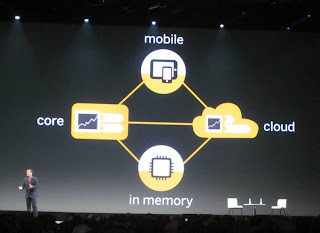
Jim Hagemann Snabe gave the Wednesday keynote, which I found tighter and more balanced than similar messages delivered in Orlando. Back then, the keynotes seemed to overly emphasis HANA, SAP’s new in-memory database technology. Although HANA is still hugely important to SAP, the message is now more balanced between SAP’s three focus areas of innovation: mobile, cloud, and in-memory computing.

I also appreciated Snabe's tone, focusing positively on SAP’s roadmap and customer success stories. This was a welcome change from recent keynotes by the CEOs of some of SAP’s competitors, whose bar-room brawling style might be more entertaining but doesn’t provide much real insight. Personally, I find Snabe’s low-key approach much more palatable, and I have to believe customers feel this way also.

So, in a nutshell, here is my bottom line: I see SAP in a period of transition with cloud computing, mobility applications, and in-memory computing. There is progress, but success is not ensured.

Business ByDesign Has Momentum, but Line of Business Apps Lagging

SAP has two major cloud initiatives: its Business ByDesign (ByD) ERP suite for small businesses and its Line of Business (LoB) SaaS applications, which complement its Business Suite.

Concerning ByD, SAP is on target to reach 1,000 customers sold by year end, although SAP executives indicate that reaching that goal might come down to the wire. Although reaching or exceeding that number will matter to some SAP folks’ year-end bonuses, I would view anything close as being a significant accomplishment. My consulting team at Strativa recently evaluated ByD in a competitive deal and came away favorably impressed. Customer reference checks during the Madrid conference were also encouraging. I believe SAP has a winner with ByD: both for subsidiaries of its large customers and in net-new small business deals. Those who question the viability of ByD at this point should reconsider their assumptions.

On the Line-of-Business side, progress is not as impressive. SAP has one SaaS application—Sales On Demand—in general release. But don’t expect to see other applications any time soon. Travel On-Demand (mostly expense reporting) will go into beta in Q1, 2012, according to Sven Denecken and Kevin Nix, who head up LoB development. Career On-Demand is scheduled to go to the first beta customer in Q2, 2012. In addition, Kevin and Sven told me of another LoB application now in development: Social Service and Marketing On-Demand. I have no target date for this product.

SAP positions these LoB applications as people-centric applications, helping end-users accomplish their daily activities. Although this is an interesting approach, the LoB apps do not have very broad functional footprints. For example, Sales On-Demand is primarily focused on the collaboration of pre-sales teams and others as they coordinate their activities for specific prospects. It is by no means a complete CRM package—it is not even a complete sales force automation app. Likewise, Career On-Demand is not a complete talent management system. Rather it is focused on helping people manage their goals, objectives, and daily activities and to see what others across the organization are working on. Finally, Social Service and Marketing is narrowly focused on processing incidents originating from Twitter and other social media channels.

In my view, the LoB applications are a defensive play by SAP, aimed at keeping its installed base from leaving the SAP-fold for newer cloud-based providers. For example, in my view, Sales On-Demand is aimed at keeping SAP CRM customers from considering Salesforce.com. Likewise, Career On-Demand is meant to keep SAP HRMS customers from considering Workday. Finally, Travel On-Demand is SAP’s answer to Concur’s expense management system. SAP may be successful in getting its installed base to adopt some of these LoB applications, but because they are not complete solutions, I do not think they are an adequate response to the threat from Salesforce.com, Workday, Concur, and others. Furthermore, it is hard to imagine non-SAP customers purchasing these solutions.

The other problem with the LoB applications, frankly, is that they are a late response by SAP. Salesforce.com, Workday, and Concur have been developing and marketing their applications for years. In the case of Salesforce.com, over 10 years, and SAP is only now starting to respond? It’s like the student who turns in (hopefully) a well-written essay, but misses the deadline.

So, on my scorecard, SAP gets an “A” for ByDesign and a “C” for its line of business applications.

Turning the Ship on Mobile Applications

On the mobility front, SAP appears to be making good progress. Based on a briefing I received, there are now 50 mobility apps available in the new SAP Store. Of these 38 are authored by SAP and 12 are from partners. There are 200 more in the development pipeline (split between SAP and partners is not clear to me).

All of the current apps in development are based on the Sybase Unwired Platform (SUP), and this is where there are some issues. The SUP is a general platform for mobility device development and management. It allows a developer to write an application and have it deployed on multiple devices, such as RIM’s Blackberry, Apple’s iPhone/iPad, Android devices, and Windows phones. It also provides an enterprise-class management platform for back-end data access, application provisioning, user and device management, and security. So from the perspective of ensuring that its mobility apps are enterprise-class, I can understand why SAP would want mobile applications developed by partners to be certified for SUP.

The problem, however, comes from the developer perspective. Many of the best mobile apps development these days are coming from small shops, and current SAP licensing practices by SUP are, shall we say, burdensome for small developers. Based on briefings we received, it appears SAP understands the obstacles in the way of small developers and wants to show some flexibility on this issue. There is talk of allowing developers to work outside of SUP and then submitting their applications for certification. There was even talk at some point of allowing apps to be sold via the SAP Store that do not run on top of SUP, but that is by no means current policy.

My colleague Dennis Howlett has a deeper dive on SAP's mobility progress.

So, it would appear that on the mobility front, SAP is in transition. They are making good progress, but they need to follow through on their good intentions to become more developer- and partner-friendly in mobile apps development.

In-Memory Computing Still Rings SAP's Bell

Although the Madrid messaging was balanced among the three areas of innovation, you can still sense the excitement among SAP executives when they come to the subject of in-memory computing. They honestly feel that its in-memory technology (HANA) will leap-frog SAP over its competition. In a small group briefing with Vishal Sikka, he spent significant time talking about the value proposition of in-memory computing to provide faster answers to business queries, without the constraints of data structures such as cubes. The value of HANA has already been demonstrated in a limited number of one-off proof of concept projects for select customers, many of whom were featured in the Orlando conference.

The next step is to scale up HANA adoption by using it as a customer platform for SAP’s business warehouse (BW) deployments. In a sidebar conversation with Sanjay Poonen, SAP’s President of Global Solutions, he indicated this is where most SAP customers will first realize the value of HANA.

Ultimately, though, SAP intends to bring in HANA underneath parts of the Business Suite—we had one briefing from a customer looking to run HANA underneath its trade promotion processing to more quickly analyze pricing trends. SAP has a far-reaching vision for HANA to ultimately become the data platform for many of its products.

So SAP is also in transition with in-memory computing: moving it from a small number of proof-of-concept case studies to a broader adoption by its customer base. This migration has only just begun.

Can SAP Make The Needed Transitions?

For the largest enterprise software vendor in the world, the roadmap is good. But is it possible for SAP to complete the needed transitions? There are strong economic rewards up front for HANA, which are big ticket license sales. But will SAP be willing to devote the resources necessary for its cloud solutions and mobility applications to be successful, where the deals are smaller? The signs are encouraging, but success is not ensured.
  1. Progress is good with mobility apps, but the partner model needs to be improved. When small mobile developer partners, like Graham Robinson, tell me they are happy with SAP’s support then I will be convinced that SAP stands a good chance of being successful. The words coming from SAP executives are the right sounds, but I’m waiting to hear confirmation from small developers that SAP’s actions are following its words.

  2. It is going to be interesting to see how SAP’s cloud computing programs proceed. For SAP, cloud is both a sustaining innovation and a disruptive innovation (to use the terminology of Clayton Christensen). From the standpoint of SAP’s large customers with many small subsidiaries, ByD is a sustaining innovation because it gives them something to offer for their subsidiaries. Many competitors, such as Microsoft Dynamics, Epicor, NetSuite, and Plex, are targeting these subsidiaries in a so-called "two-tier ERP" strategy. Thus, ByD preserves and extends the revenues that SAP receives from these large customers.

    The larger question is whether ByD can consistently beat out cloud-based competitors such as NetSuite, Plex, or Rootstock for net new deals in small organizations. As I indicated, the signs so far are good. But will SAP be willing to invest what it takes for such small deals? Furthermore, will SAP be willing to let ByD naturally grow up-market and start to disrupt (cannibalize) its sales of SAP All-in-One or even its Business Suite? If so, then I would declare victory for ByD as a truly disruptive innovation.

    I do not view SAP’s LoB applications as disruptive. These apps are targeted primarily at SAP’s installed base and are therefore a sustaining innovation for SAP. They do not need to be best-in-class. They only need to be good enough to keep customers from going with SFDC, Workday, Concur, or other pure best-of-breed cloud solutions. But, as noted earlier, these are not complete solutions and may not be enough to keep SAP customers from looking elsewhere. Also, they are unlikely to find much of an audience outside of SAP’s installed base.

  3. Although I would agree generally with Vishal’s assessment about HANA, from an economic standpoint, in-memory computing does not require SAP to transition its thinking or business model. From an economic standpoint, in-memory computing is a sustaining innovation for SAP. SAP can use in-memory computing to continue to sell big-ticket licenses to big-ticket customers and receive large annuities in the form of maintenance fees. It is not like cloud and mobile which require that SAP make changes in its expectations on how it will make money in the future.
So in terms of transition, I think SAP has made the most progress with cloud computing, with Business ByDesign but not with its line of business applications. The direction with mobility applications is good, and SAP is making the right noises about working with small developers, but it is too early to see words translated into action. Finally, even though in-memory computing is still early in its roll out, it stands a good chance of success if SAP can gain adoption beyond its initial proof cases, because it does not require SAP to change its business model.

I made some of the same points in a very short interview with Dennis Howlett, during the Madrid conference. You can watch the interview below.


Postscript: I’ll repeat here what I said to my SAP host when I bid goodbye from the Madrid conference: I know some of us often give SAP a hard time. But we do it for one reason: we care about SAP’s customers, just as SAP does, and we want SAP to be successful for their sake.

Disclosure: SAP paid part of my travel expenses to attend the Madrid conference.

Sunday, November 06, 2011

Cutting Through the Fog of Cloud Computing Definitions

In recent years, the term "cloud computing" has been used and abused by vendors and their marketing groups to denote just about anything the vendor offers other than on-premise systems. Analysts too have piled on, each offering their own definition of cloud computing. This 2009 Wall Street Journal article outlined the confusion. The result has been fruitless arguments over what is "true cloud" or "false cloud," as in the recent tit-for-tat speeches by Larry Ellison and Marc Benioff during Oracle Open World.

Such debates are likely to continue, but now there is at least one official source for the definition of cloud computing. The National Institute of Standards and Technology (NIST), an arm of the US Department of Commerce, has now published The NIST Definition of Cloud Computing. Though other standards bodies may (or may already have) published their own definitions, NIST carries particular weight as it is often referenced in U.S. governmental procurement. The NIST definition is vendor-agnostic and buyer-centric.

The NIST Definition

The NIST document is short--the body of the document comprises just three pages, with the definition itself taking up less than two pages. In it, the authors describe the essential characteristics, service models, and deployment models for cloud computing.
  • The five essential characteristics are: on-demand service, broad network access, resource pooling, rapid elasticity, and measured service.
  • They go on to then list three service models, which should be already familiar to most observers: software as a service (SaaS), platform as a service (PaaS), and infrastructure as a service (IaaS).
  • Finally, they list four possible deployment models for cloud computing: private cloud, community cloud, public cloud, and hybrid cloud.
In my mind, the section that is most useful for distinguishing what is or is not cloud computing is the first one, the "essential characteristics." So, let me quote NIST directly (emphasis mine).
Essential characteristics:
  • On-demand self-service. A consumer can unilaterally provision computing capabilities, such as server time and network storage, as needed automatically without requiring human interaction with each service provider.

  • Broad network access. Capabilities are available over the network and accessed through standard mechanisms that promote use by heterogeneous thin or thick client platforms (e.g., mobile phones, tablets, laptops, and workstations).

  • Resource pooling. The provider’s computing resources are pooled to serve multiple consumers using a multi-tenant model, with different physical and virtual resources dynamically assigned and reassigned according to consumer demand. There is a sense of location independence in that the customer generally has no control or knowledge over the exact location of the provided resources but may be able to specify location at a higher level of abstraction (e.g., country, state, or datacenter). Examples of resources include storage, processing, memory, and network bandwidth.

  • Rapid elasticity. Capabilities can be elastically provisioned and released, in some cases automatically, to scale rapidly outward and inward commensurate with demand. To the consumer, the capabilities available for provisioning often appear to be unlimited and can be appropriated in any quantity at any time.

  • Measured service. Cloud systems automatically control and optimize resource use by leveraging a metering capability at some level of abstraction appropriate to the type of service (e.g., storage, processing, bandwidth, and active user accounts). Resource usage can be monitored, controlled, and reported, providing transparency for both the provider and consumer of the utilized service.
Keep these key points in mind.

Cutting Through the Ellison/Benioff Fog

So, let's apply these characteristics to what Larry Ellison and Marc Benioff each describe as cloud computing. In my opinion, both are right and both are wrong.

Benioff's service, Salesforce.com, certainly meets the NIST definition of cloud computing, both in its CRM application, which meets NIST's definition of SaaS, and in its Force.com offering, which meets the definition of PaaS. He is also correct in criticizing the labeling of Oracle's Exalogic hardware as a "cloud in a box." By my reading of NIST's essential characteristics, one could construct a cloud service using Oracle's hardware, but the hardware itself should not be considered a cloud.

But if Benioff is referring to Oracle's newly announced Public Cloud Services as a "false cloud," he is wrong. Oracle's Public Cloud Services certainly meet the NIST definition of cloud computing. But it is primarily an IaaS offering, similar to Amazon's EC2. Assuming that Oracle will offer development capabilities on top of its Public Cloud Service, those would be PaaS, and if it chooses to run applications on top of its Public Cloud Service, such as Oracle CRM On-Demand, those would be SaaS.

On the other hand, Ellison is wrong to label Salesforce.com's PaaS offering as a "false cloud." Ellision's argument is that Force.com utilizes proprietary extensions to Java and other programming languages, which make it difficult to migrate applications to other cloud providers. But there is nothing in the NIST definition of cloud computing that requires interoperability between different cloud service providers, as desirable as that may be. Ellison is simply turning what he sees as a disadvantage of Benioff's cloud into an argument that it is by definition not a cloud.

Cutting Through the Application Hosting Fog

The NIST definition is also useful for cutting through vendor marketing efforts to label anything they do off-premise as cloud computing. In particular, application vendors that simply host their on-premise solutions in their own, or partner, data centers should not be labeling those as cloud computing. In particular, simple hosting of an application does not qualify as cloud computing because it lacks the essential characteristics (see bolded sections in the quoted definition above).

With a hosted application, the customer generally cannot "unilaterally provision computing capabilities, such as server time and network storage, as needed automatically without requiring human interaction." In addition, with a hosted application there is generally no "sense of location independence." Rather, the customer usually knows the data center and may even know the data center, cage, or rack in which his hosted application resides, even if the application is hosted on a virtual server. Finally, with a hosted application, computing resources generally cannot be "elastically provisioned and released, in some cases automatically, to scale rapidly outward and inward commensurate with demand." Rather, the customer must negotiate provision of additional computing resources.

Notice also that the NIST definition does not mention anything about how cloud services are contracted. Some vendors point to subscription pricing as evidence of their hosted applications being cloud offerings. According to NIST, how the customer pays for the service has no bearing as to whether the service is cloud computing. It could be subscription pricing, it could be a perpetual license, or it could be something else.

The marketing hype and confusion over cloud computing will no doubt continue. But at least now NIST offers a reasonable and objective definition.

Related posts

Salesforce.com: more than an itty-bitty application
The inexorable dominance of cloud computing
Lawson's cloud services: good start, but no SaaS
A game-changing play in enterprise software

Friday, October 28, 2011

How to Become a Chief Innovation Officer

I had a real treat this week: I was invited to give a presentation to 25 CIOs at Infor's European CIO Advisory Council meeting, in Maranello, Italy. If you are not familiar with Maranello, it's famous as the town of the headquarters of Ferrari, which is an Infor customer. More on Ferrari at the end of this post.

Infor's Integration Strategy

The event was kicked off by Infor's CEO, Charles Phillips, who came into the top job last December, from his previous position as Oracle's co-President. It was a good opportunity for me to see how Charles deals up close with Infor customers, some of whom were meeting him here for the first time. Charles demonstrated a detailed knowledge of Infor's product portfolio and an ability to outline complex product strategy in business terms.

To that point, Charles gave the best explanation I've heard to date on Infor's integration strategy. Infor's Intelligent and Open Network (ION) is a lightweight middleware product that provides integration between various Infor products, between those products and third-party applications, and between those products and customer/partner developed systems. It is "lightweight" in that it is not optimized for specific transactions or point-to-point integration. Rather each application publishes a complete XML document for each transaction (e.g. a sales order), to which other ION-aware applications can subscribe asynchronously. ION stores all XML documents in a business vault, for reporting purposes and, I assume, to satisfy any regulatory compliance needs for audit trails.

According to Charles, ION is not appropriate for every application (e.g. an equities trading platform requiring subsecond response time would not be a fit), but it meets the need in a simple way for enterprise business applications, such as ERP, CRM and supply chain management. Infor is now in the process of ION-enabling each of its products for approximately 93 business transactions.

The best part is that ION ships as just three CDs, which, according to Infor, can be installed in about 10 minutes.

Infor's Challenge

So are all Infor customers ready to move forward with ION? Not quite. From group discussions and hallway conversations, it is clear that Infor's challenge is to get customers to current releases of their Infor products, where they can take advantages of Infor's new capabilities.

To be fair, this problem is not unique to Infor but common to all enterprise software vendors with large and long-standing installed bases. Many customers purchased their ERP systems years ago, and for good and not-so-good reasons they may have made hundreds or thousands of code modifications. Although they may have seemed justified at the time, these modifications now make it nearly impossible for customers to upgrade. In successful case studies mentioned by Infor executives, the only thing that seems to work is to take a clean-sheet-of-paper approach: put the latest software version in front of users in a conference room pilot and ask, "What's missing?" If you start with the assumption that each previous modification is still needed, the whole project collapses under its own weight.

How to Become a Chief Innovation Officer

This background turned out to be a good set-up for my presentation. I shared that the job of the CIO is becoming more difficult. CIO budget increases in most companies are severely limited, while at the same time CIOs are being asked to do more: support business change (which is increasing) as well as new technology innovations, such as mobile applications, business intelligence, new customer-facing systems, and social business.

The risk for CIOs under these pressures is that they may become, essentially, irrelevant. According to our research at Computer Economics, 75% of CIO budgets go toward ongoing support, leaving only 25% for innovation. With limited time and money, the CIO is forced to defer many business requests for new initiatives, and when users can't get what they need from the CIO, they begin to develop their own systems and IT capabilities. Eventually, the business stops asking the CIO for new stuff, and the CIO slowly becomes just a "Chief Infrastructure Officer," maintaining existing systems.

In such an environment, how can the CIO grow into a "Chief Innovation Officer?" I outlined the key steps.
  1. Optimize the Infrastructure. The first step is to lower on-going support costs to free up money for innovation. Understand your current cost structure and where there are opportunities to upgrade and consolidate the infrastructure and applications portfolio. Adopt key IT management best practices for incident management, problem management, and change management, which further lower costs and improve service levels. Cloud computing can also play a role here as a way of quickly rolling out new systems that build upon the organization's core transactional processing systems.
  2. Become a Chief Integration Officer and Chief Intelligence Officer. Once the infrastructure has been optimized, the CIO now has the credibility and ability to expand his or her role to become a Chief Integration Officer (focused on end-to-end business processes and customer/supplier integration) as well as a Chief Intelligence Officer (focused on turning internal and external data into useful information and deploying it to the organization through a variety of channels).
  3. Become a Chief Innovation Officer. The CIO is now not only reacting to and supporting the business strategy but also leading the business into new IT-enabled products and services.
I finished with a warning. Becoming a Chief Innovation Officer is not a one-time promotion. Today's innovation becomes tomorrow's infrastructure. Just as personal computers and email were once seen as innovations in IT, today they are just part of the infrastructure. Any CIO today who is focused on PC maintenance or email administration risks becoming irrelevant. So also, tomorrow, mobile applications, tablet computing, and business intelligence will become commonplace as elements of tomorrow's infrastructure. The CIO's challenge is to continually learn and grow.

The Need for Speed

Our two days together were not all work and no play. As part of the event festivities, Infor arranged a tour of the Ferrari Museum and a Ferrari test drive around Maranello for all the attendees. I put together a little video of my Ferrari driving experience, which you can view here.

Disclosure: Infor paid for my participation in this event.

Related Posts

New details on Infor's Lawson acquisition

Tuesday, October 18, 2011

Risks and Opportunities with SAP's Platform Economics

Unless you hang around with SAP developers or independent SAP analysts, you may not be aware that there is a conflict brewing over how SAP wants to charge for its new technology platforms. Specifically, the Sybase Unwired Platform (SUP), which SAP acquired for developing mobile applications, and the SAP Netweaver Gateway, which SAP built to allow third-party applications and devices to connect seamlessly with SAP back-end processes.

The conflict is this: SAP wants to make money, on some basis, for SUP and the Netweaver Gateway, while any fees charged for these platforms discourage third-party development and increase the cost for customers.

Dennis Howlett has been hammering on this subject for many months, encouraging SAP (pleading might be a more appropriate word) to offer these platforms at low-cost or no-charge. He calls it the "Apple model," in recognition of how the free-nature of Apple's development platform has enabled thousands of developers to write third-party applications for Apple's iPhone and iPad. At SAP's annual user conference in Orlando this year, I heard him bring up this point directly with SAP co-CEO Bill McDermott. Bill appeared interested, but non-committal. After the conference, Dennis wrote about SAP's mobile platform, on a downbeat note:
The main problem comes in the licensing model. I find it staggeringly backward thinking that SAP almost invariably finds it necessary to monetize everything that has running code attached to it. That world has been left behind. If SAP could mobilise itself to think differently to the way it is accustomed it could (almost) easily bulk up without having to find another mega acquisition that inevitably amplifies disruption.
Now, just this week, Dennis called my attention to a post written by a third-party SAP developer Graham Robinson on SAP's own SDN site, which strongly confirms SAP's problem:
So let's say I come up with my own killer app. It is an all-singing all-dancing mobile application that will provide huge business benefit to lots of SAP customers. In fact it is so good I can sell the idea to my favourite customers (those that trust me) with a business case that they will jump at. So I have the idea, I have the funding and foundation customer commitment - I am ready to go. So time to decide what technology I should use to build my application with. Let me focus on NetWeaver Gateway but I think similar arguments apply to the [Sybase] Unwired Platform.

....I see NetWeaver Gateway as a programmer productivity tool. It provides a method for exposing SAP functionality using those standards mentioned - but we ABAP developers have been able to do that for years....I am not saying I am not interested in a toolset and/or framework from SAP that does this sort of thing as well, I am. But really the value proposition is that NetWeaver Gateway will save me development time on the backend in publishing the services I want to consume in my application.

BTW - I do not believe NetWeaver Gateway saves me any time developing the front end application despite all the great "app in a minute" demos we have seen. Whether I use NetWeaver Gateway to expose services or I handcraft my own as long as I conform to industry accepted standards the front end development tool should be able to introspect and the runtime consume these services identically.

So back to my killer app. Why should I take the funds my customer has committed to my app and pass some of them onto SAP? Even assuming I could get a straight answer from SAP on what the price would be - why should I do it unless the benefits outweigh the costs? How can a recurring pricing model on a piece of technology be weighed up against the value of saving me development time on a project I already have approval for? And why should I just let dollars go to SAP for my idea? And by the way my customers' employees (the target audience for my killer app) are already licensed to use SAP anyway. Why should they pay again? ....

Returning briefly to the [Sybase] Unwired Platform - how do I justify the cost (albeit unqualified) of this platform against the benefits of my single, albeit killer, app? I can't. And even if I could why would I confuse my customer with extra technology and extra licensing when I don't need to? I wouldn't
....

The real problem is that SAP are struggling to find a way to monetise the millions, probably billions, of users they envisage connecting to their customers' SAP systems via the internet. These will be their customers' customers, their customers' suppliers, their customers' prospects, Joe Average searching for the cheapest widget. Basically it could be everyone in the world with a smart phone.

This is a new-ish problem, but I am sure SAP looked for old business models to learn from. I suspect the business model they took on board is that of the utility companies. IDEA! Let's put a meter on the edge of the SAP landscape and charge for use just like the electricity, gas and water meters on the edge of everyones property. (In case I wasn't obvious enough - SAP NetWeaver Gateway is the meter) Kar-ching! Brilliant! [Emphasis mine.]
Read the whole thing, as Graham goes into more depth in his full post.

Some Monetization May Be Appropriate

After reading Graham's post, I reconnected with Dennis Howlett on this subject. Interestingly, Dennis does see an opportunity for SAP to monetize these two platforms for a select group of customers--its largest customers, who will use these platforms for their own revenue generation. Dennis writes:
SAP believes its largest customers will pay for SUP because they will use it to develop apps for their own purposes from which SAP would likely see little or no economic benefit. These companies - as Gartner has indicated - could easily turn into applications suppliers in their own right, building their own IP on the side of what SAP can offer for the benefit of their ecosystems. The nearest equivalent would be the proprietary EDI mechanisms the likes of Toyota and Dell created which went right through their supply chains.

That's a model I would expect to emerge because the value that can be driven is clear, clean and in the control of the channel master. Therefore, there is a case for SAP charging that fits their model and satisfies the needs of those very large customers. But it will be limited to SAP's top 400-500 customers and does not bring with it a sustainable model. At best it is a series of one-off deals that in total would likely be worth no more than $2 billion in license revenue and $450 million in annual maintenance, based upon past performance, Sybase pricing, discounts, bundling and the like.

However, such models cannot hope to cover all eventualities or for that matter the whole of the market. We can envisage thousands of situational, ad hoc, even one-off applications where the need for fast tracking is paramount or where value comes from volume usage. This is already happening in the Salesforce.com universe where cloud brokers like Appirio are working on a 4-6 week develop/release cadence for proof-of-concept to initial deployments. Having ready access (which has to include easy, clean, cheap licensing) is the only model framework that will encourage those types of developer shop to flesh out the 80% SAP claims it wants to see from its ecosystem. In other words, it is no longer about the fear of leaving money on the table. It is about investing now for benefit that accrues to everyone.
He concludes, "If SAP does that, then it will fulfill its promise of being a good citizen in the enterprise apps landscape."

SAP at a Tipping Point

I'm not sure SAP realizes how precarious its position is, and it works two ways.
  1. SAP charging for the SUP and Netweaver Gateway creates "friction" for both developers and customers. As Graham points out, he has no real economic incentive to develop for these platforms, which will eat into the budget his customers have allocated for his development projects.

  2. The desktop analogy: when you license SAP, do you pay an additional license fee to use your desktop computer as a user interface? Of course not. SAP customers are already paying maintenance fees for enhancements to their SAP products. Why should those customers have to pay SAP an additional license fee to use a mobile device instead of a desktop computer? Even if those mobile applications add functionality to the SAP applications the customer has licensed--isn't that what the customer is supposed to get by paying maintenance fees?
SAP charging for the SUP and Netweaver Gateway further opens the door to competitors, such as Workday, who are bundling mobile applications at no charge. I fear that SAP is just giving customers another reason to consider alternatives to SAP.

My own work with SAP customers tells me that, in many accounts, SAP is not at the center of the action as it thinks it is, especially when it comes to line-of-business users, which SAP hungers after. Many of these customers are actively looking for new functionality, and they generally take a look at SAP's offerings. But it doesn't take much to nudge them into the welcoming arms of another provider, whether it be for CRM, customer service, or --yes--mobility applications. SAP argues that the integrated nature of its Business Suite and ability to support end-to-end processes gives it a strong advantage with its installed base. My work with SAP customers tells me otherwise. Yes, there are benefits to integration. But that alone is not enough to keep customers in the SAP fold when there are strong economic incentives, or perceived functionality advantages, from competing solutions. Throw up an economic disincentive to adoption of SAP's SUP or Netweaver Gateway, and customers may be quick to look elsewhere. Many won't migrate away from SAP, but they'll wall it off and implement new stuff around it from competing suppliers.

The Entitlement Mentality

What concerns me about SAP's attempt to monetize these two platforms is, once again, the mentality of entitlement. We saw it previously with the battle over SAP's attempt to increase its maintenance fees across the board to 22%. SAP consistently gives the impression that, because of its market dominance in the past, that it is somehow entitled, not only to continuing revenue from its customers, but an increasing share. It does not give the impression that it is concerned about losing ground to upstarts in the cloud, such as Workday or NetSuite, or its traditional competitors, such as Oracle, Microsoft, Infor, IFS, or dozens of others with niche industry functionality.

SAP apparently views its SUP platform and Netweaver Gateway as a way to gain new revenue. I view them primarily as a way of keeping the revenue it's already receiving.

SAP's Opportunity

If SAP can free itself from its entitlement mentality, it has an enormous opportunity with its installed base, which is the largest in the world, including many or most of the world's largest companies.

Such companies have a huge legacy investment in SAP, both in terms of historical data and business processes built around SAP software. Many of these customers would love to stick with SAP for mobile applications, which by most accounts will become the primary way that business users connect with business applications. If the SUP is low or no cost for the majority of customers, it will encourage thousands of developers, such as Graham, to embrace it, and tens of thousands of customers to make it part of their applications infrastructure. The same economics apply to the Netweaver Gateway. If SAP really wants to lock-in its customers, it should offer these platforms to the majority of its customers at low or no charge. This will liberate business value to SAP's installed base, ensuring SAP's relevance for years to come.

Whether SAP truly recognizes this risk and opportunity remains to be seen.

Updates: Others have been pounding away on these points for some time. Here are some other good perspectives on this subject.
  • Jarret Pazahanick: Is SAP Using the Right Mobility Strategy. Jarret, an SAP mentor, outlines several ways in which SAP could make more money by not charging for SUP.

  • Dennis Howlett, John Appleby, and Vijay Vijayasankar discuss in this 13 minute video the need for SAP to roll out an Apple-style apps store model, including – in their view – the need to give away the platform. SAP’s progress on mobility is assessed, and they ask, “Is SAP Listening?”

  • Jon Reed covers a lot of ground in his post on SAP at the Crossroads, but be sure to read section 4 toward the bottom on "How Can SAP Win the Hearts and Minds of Developers?" As a bonus, there is an excellent video interview of Graham Robinson who makes many of the same points as he did in his blog post quoted at the top of this post.
I'll add more links as I come across them.

Related Posts

Mad as hell: backlash brewing against SAP maintenance fee hike
SAP innovating with cloud, mobile and in-memory computing

Thursday, September 22, 2011

Breakthrough in Material Planning: Demand Driven MRP

For the first time in over 30 years, Material Requirements Planning (MRP), is undergoing a fundamental improvement. A major new development, dubbed Demand Driven MRP (DDMRP) is moving from theory to practice, and the results are impressive. If you care about manufacturing ERP, you would be wise to pay attention.

Carol Ptak recently called my attention to her work with Chad Smith at the Demand Driven Institute, which they founded in 2010 to promote the concepts of DDMRP. I've known Carol for many years, through her work as past President and CEO of APICS and her time at PeopleSoft, where she was an early proponent of making MRP more "demand driven." I wrote a brief blog post in 2003 covering this subject (see: PeopleSoft Strengthens Its Manufacturing Offerings by Acquiring Demand Flow).

So, I jumped at the opportunity to set up a briefing on DDMRP with Carol and Chad for me and my associates Bob Gilson and Nick Hann at Strativa.

Bringing MRP into the 21st Century

Before we look at some of the key concepts of DDMRP, let's review the history of material planning.

MRP, first developed in limited fashion in the 1950s and 60s, really took off in the 1970s, when computer systems enabled widespread adoption and APICS undertook the "MRP Crusade" to popularize it. It was a great advance over previous material planning techniques, such as statistical order point (popularized during the Second World War), which viewed each inventory item separately. The big conceptual breakthrough of MRP was to separate dependent demand (sub-assemblies and purchased items) from independent demand (e.g. finished goods and service parts). MRP, therefore, provided a holistic, or system-wide view of inventory.

MRP (material requirements planning) morphed in the late 1970s and 80s into MRP II (manufacturing resource planning) and ultimately ERP (enterprise resource planning). But the heart of today's ERP systems (at least in the manufacturing sector) is still the MRP processing logic that is essentially unchanged since the 1970s.

In practice, MRP relied heavily on demand forecasts to drive planning and used safety stock inventory to cover variability in lead-times and forecast errors. The results, though far better than the old order point systems, were often excess inventory and less-than-acceptable customer service levels.

Just-in-Time (JIT) inventory and lean manufacturing techniques were, in part, a reaction to the complexity of MRP and a desire to obtain better outcomes. Introduced in the 1980s, JIT was a simplification in material planning and it took inspiration from the quality management movement and Toyota Production System in Japan. JIT is essentially a "pull system"--relying upon simple demand signals, such as Kanbans, from customers to suppliers up and down the supply chain, often with little or no computerized support. Unlike MRP, which viewed inventory as an asset, JIT viewed inventory as a "waste" and sought to minimize it wherever possible by minimizing variation in supply and demand, and reducing setup times to enable smaller lot sizes. But its emphasis on inventory reduction, lack of a system-wide view of inventory, and incomplete planning equation created brittle supply chains, subject to disruptions.

Embracing and Extending MRP and JIT

Demand Driven MRP is not a completely new method: it builds upon and extends the concepts of MRP while borrowing the best features of lean manufacturing. Like lean manufacturing, it seeks to "align efforts and resources as close as possible to actual demand" (a so-called pull system) while at the same time, like MRP, provide "visibility to the total requirements and status picture across the enterprise."

The authors' background in the Theory of Constraints is evident. They are not looking to compromise between MRP and lean manufacturing. Rather they recognize and seek to satisfy the legitimate objectives of both. For example:
  1. The greatest extension of DDMRP is the introduction of supply chain modeling prior to generating material plans, as shown in steps 1-3 in the Figure at the top of this post. Here, the organization determines the optimum places where inventory should be held. This is a step that MRP simply does not address. MRP and even Advanced Planning systems (APS) generally take inventory stocking points and safety stock levels as givens and plans within them. At the opposite end of the spectrum, JIT techniques are blind to the overall supply chain. Each node of a pure pull system is only sensitive to the demand at the next downstream operation. DDMRP, on the other hand, models where inventory should be held in order to minimize lead times and reduce variability where it matters the most.
  2. In terms of inventory, DDMRP stakes out a middle ground between MRP and lean manufacturing. It does not view inventory as a waste, as lean manufacturing does with its goal of "zero inventory," and it does not seek to establish safety stock levels in a static way, as MRP generally does. Rather it seeks to hold the right amount of inventory at the right place in the supply chain "to promote flow but minimize working capital," and "to size and dynamically adjust those strategic stock positions" based on a set of rules dominated by six factors.
  3. DDMRP deals with lead times in a more realistic fashion than traditional MRP, which in calculating manufacturing lead time assumes all components are in stock, or in calculating cumulative lead times assumes nothing is in stock. Neither are good assumptions in most environments today. DDMRP introduces a concept it calls Actively Synchronized Replenishment (ASR) Lead Time (ASRLT), which represents "the longest unprotected sequences in the bill of material" where "protection" is defined by strategic stocking points. These points decouple, compress, and ultimately define the calculated lead time of an item.
  4. MRP is only a planning tool and JIT is only an execution tool, whereas DDMRP is both a planning tool (in the modeling and planning stages) and an execution tool, in the execution stage (see Figure at top of this post).
  5. DDMRP greatly reduces the emphasis on accurate forecasts in driving supply plans. Demand is driven entirely or largely by actual customer demand (typically sales orders), which can then be satisfied from compressed lead time due to the strategically placed inventories at the subassembly or component level.
These are just a few of the key concepts of DDMRP. For a more complete view, see the additional resources listed at the end of this post.

If there is any doubt that DDMRP is a major breakthrough, consider this: the book everyone considers the "Bible" of MRP was written in 1974 by the late Joseph Orlicky, and the second edition was authored in 1994 by the late George Plossl. McGraw-Hill, publisher of Orlicky's Material Requirements Planning has just released the third edition, which is authored by Carol Ptak and Chad Smith, the brains behind DDMRP. This third edition now incorporates the concepts of DDMRP, building upon the work done by Orlicky and Plossl, two of the fathers of MRP.

Proof in the Pudding

Think DDMRP is just a nice theory? Not so. The benefits have already been demonstrated by at least two early adopters:
  1. Oregon Freeze Dry, after adopting DDMRP, saw a 20% increase in sales 20% and 60% inventory reduction in one division, along with 60% reduction in make-to-order lead-time and 20% inventory reduction in another division.
  2. LeTourneau Technologies (LTI) is an interesting case study in the natural resources sector. The firm implemented DDMRP in one of its two plants, while letting the other plant continue with traditional MRP. Both plants had similar resources, bills of material, and material planning personnel.

    During a boom and decline cycle of 2005 to 2008, the DDRMP plant grew revenues from $270M to over $620M, while growing inventory by only about $80M. In contrast, the traditional MRP plant experienced the similar growth in revenues, but inventories grew at the same pace. When the recession hit in 2008, the DDMRP plant , however, was well positioned with lean inventories while the traditional MRP plant was exposed to a huge amount of inventory liability.
Additional case studies should begin to appear as other organizations gain experience with these new methods.

What's Next?

I believe that enterprise software vendors, especially those focused on supply chain management, are going to move quickly to begin to incorporate DDMRP concepts into their systems. So far, there is only one software provider that has done so, Replenishment+® from Demand Driven Technologies, of which Chad Smith is a paid advisor. However, I see indications that some other vendors are moving in this direction. In other words, I do not believe availability of software is going to be an obstacle.

If there is any obstacle to wholesale adoption of DDMRP, it is going to be in the general level of resource planning skills in many manufacturing organizations. The concepts behind DDMRP are not simple. Many practitioners tasked with responsibility for MRP systems today do not have a deep understanding of MRP principles, even of traditional MRP circa 1974. How are they going to grasp the concepts behind DDMRP? I think this will be the key limitation hindering widespread adoption, unless manufacturing organizations are willing to re-invest in professional development in a sustained way. Conceptual education--not just software training--is going to be key.

A corollary observation is this: production and material planning is going to become an even more critical function for manufacturing and distribution firms. It always has been, of course, but it will become even more critical in industries where some players have the skills to adopt DDMRP and others don't. No longer just a back-office function, resource management should once again become an inviting career path for young people.

Additional Resources

There is much more to DDRMP than I can outline here, such as its ability to accommodate seasonality, ramp up/down in production, and end-of-life scenarios, all of which are troublesome for traditional MRP systems and especially lean-manufacturing systems. Therefore, it is best to point readers to the following resources.
  • Demand Driven MRP. The flagship DDMRP website maintained by Carol and Chad, with a good introduction to DDRMP. Free white papers, videos, and podcasts are available on a number of DDMRP topics.
  • Demand Driven Institute. The educational and consulting organization promoting the concepts of DDMRP. The textbook I mentioned earlier, Orlicky's Material Requirements Planning, Third Edition, is also available here, with a supplemental DVD.
  • Orlicky's MRP. This is the official website of the new edition of Orlicky's Material Requirements Planning.
There are several white papers and videos linked at these sites that go into more depth on DDMRP. Training classes are now being rolled out. In addition, the authors will be presenting more on this subject at the APICS International Conference in Pittsburgh, October 23-35. If you are planning to be at this conference you will be wise to register for this session, as it will probably be standing room only.

Related Posts

APICS Returns to Its Roots
PeopleSoft Strengthens Its Manufacturing Offerings by Acquiring Demand Flow
Lean Manufacturing: Not a Complete Solution without Information Technology
Lean Manufacturing Doesn't Really Need Software, But Software Can Help
Lean Thinking is Still More Than Software